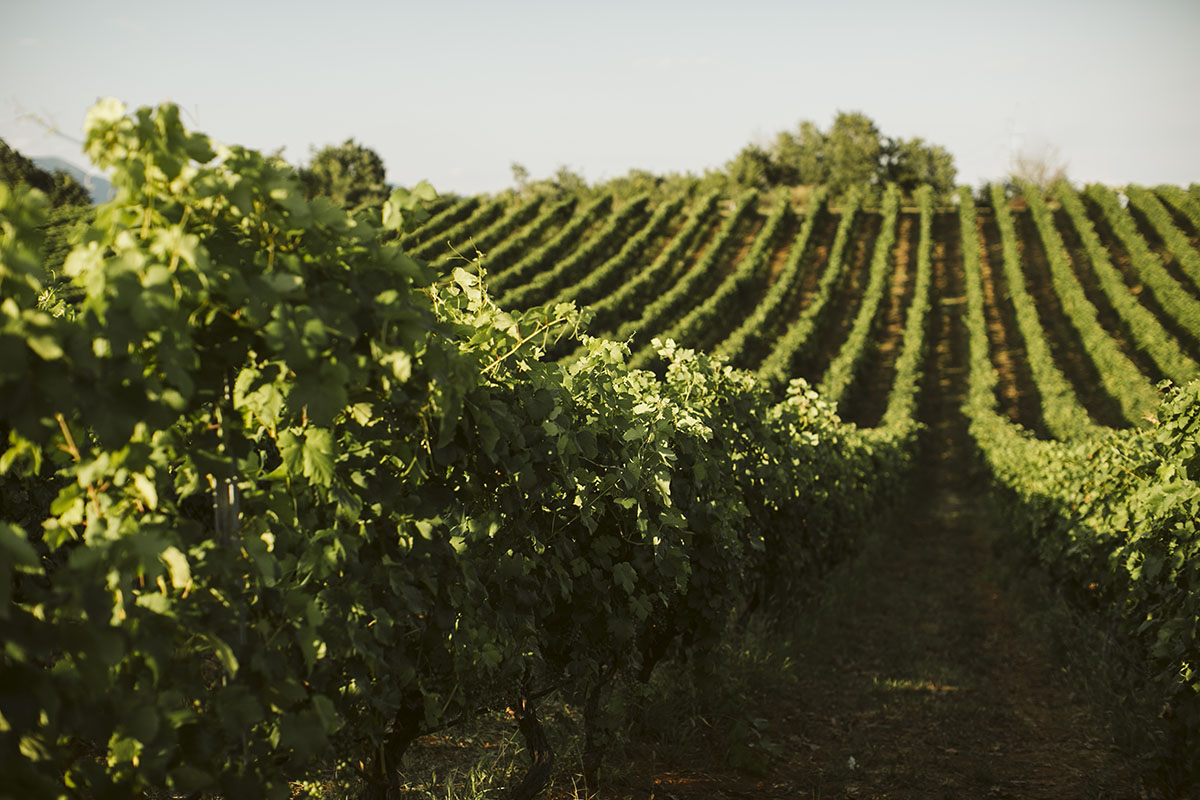
Our story begins in 1958, when Efthymios Apostolidis planted the first vineyard in Dialekto, Kavala, on the foothills of the Macedonian mountain basin, near the Nestos River and the borders of Thrace. Due to the difficulties of that era, wine production was carried out only on an amateur level. That is, until 1981, when his son, Ioannis Apostolidis, took over the vineyard with renewed determination.
By 2003, production had reached 3 hectares. A new chapter opened in 2007 with the establishment of an ultra-modern, visitor-friendly winery covering an area of 10 hectares. Soon, the third generation—Vasiliki and Efthymios Apostolidis—assumed leadership of the business.
The winery moved forward with new, strict, and high-quality objectives, implementing innovative methods both in the vineyard and in the cellar. Today, the family’s 13 hectares of vineyards are cultivated using biodynamic practices.
INNOVATION & DEVELOPMENT
For us, wine is a sum of different components that must be researched, discovered, and interconnected.
Connected to nature, we are challenged to adapt to it, taking risks in order to constantly improve quality.
It requires the will and persistence to explore nature and ourselves.
Thus, if we aim to highlight vitality, freshness, and precision in our future wines, we must understand natural conditions and work with different elements while respecting the environment.
BIODYNAMICS
Biodynamics (Greek bios = life, dinamikos = movement) is a method of agricultural renewal based on the principles of anthroposophy.
The Austrian philosopher Rudolf Steiner founded this worldview and understanding of the human being in the early 20th century.
According to anthroposophic thinking, a farm functions as an autonomous microcosm containing a diversity of plants and animals. Even in cultivated nature, there is a closed cycle between soil, plants, and the natural world.
As a winery, we have set the goal of preserving and expanding this complex ecosystem and making it our ally.
HARNESSING THE FORCES OF NATURE
We consider a vineyard to be a living organism. Behind it lies a complex ecosystem in which the microcosm is connected to the macrocosm.
Taking into account the rhythms and cycles of nature—cosmic influences such as those of the sun, the moon, and the stars—we use their forces to our benefit.
In this way, we work with nature rather than against it, ensuring successful agriculture.
In the 21st century, we humans have forgotten how to understand and use the knowledge passed down by our ancestors—knowledge gained through thousands of years of observation to guide their work.